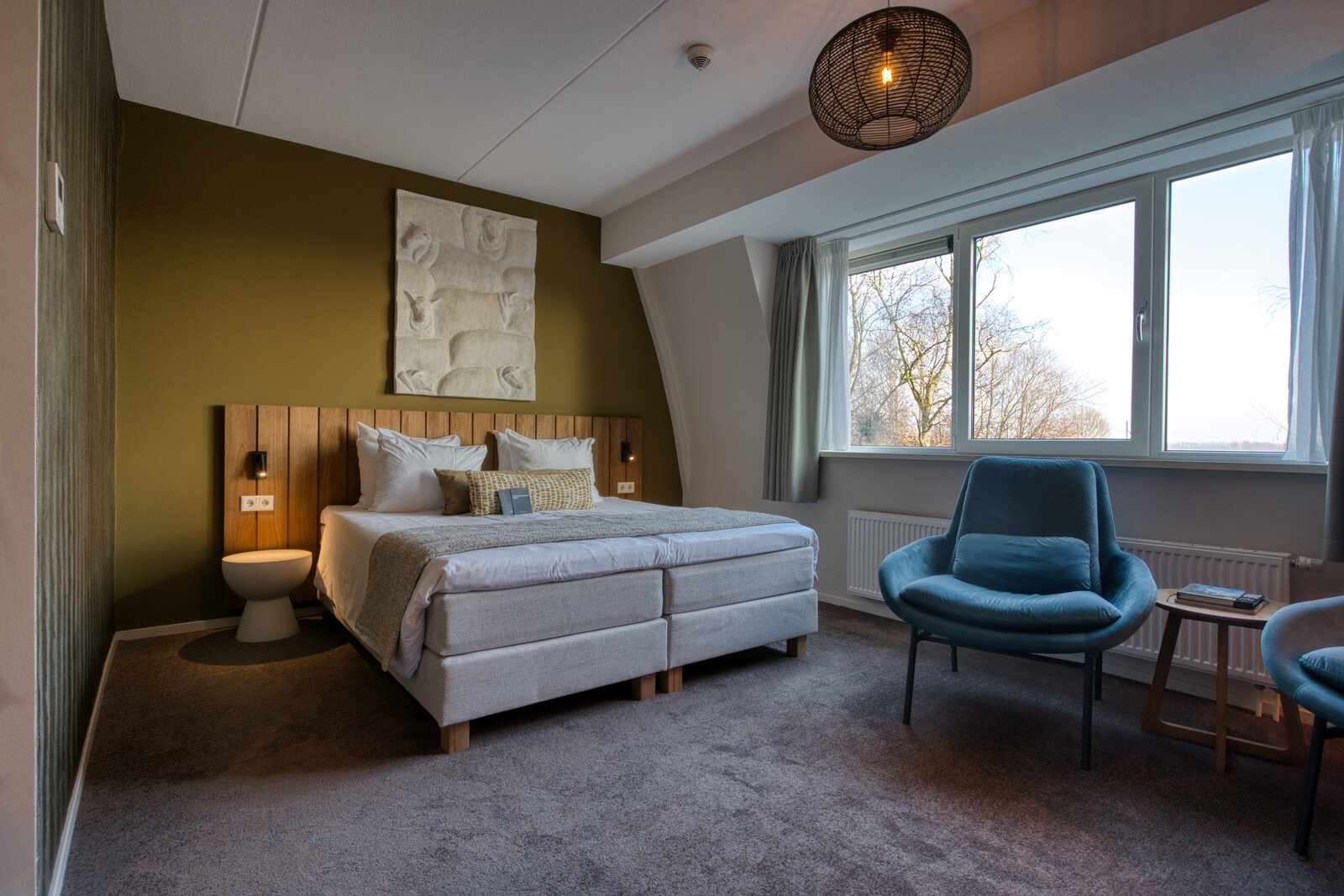
A beautiful hotel room is not automatically a reason to book. Neither is a good breakfast, a swimming pool, a central location or late checkout. Because before guests can experience any of those things, they first have to choose your hotel.
And that choice increasingly starts long before someone walks through the front door. Potential guests discover destinations on social media, search on Google, compare hotels, browse websites, read reviews and check booking platforms. Often, they form an opinion about your hotel before they have ever spoken to anyone on your team.
That is why hotel marketing is no longer simply about being visible.
Effective hotel marketing means reaching the right guests, giving them a reason to care and making the experience of staying with you tangible before they arrive.
And that requires more than beautiful photography or posting several times a week. It requires direction.
What is hotel marketing?
Hotel marketing includes all strategies and activities used to attract potential guests, influence their decision and ultimately generate bookings, repeat stays and recommendations. Hotel marketing can include:
- brand positioning
- branding
- your hotel website
- hotel SEO
- local SEO
- social media marketing
- photography and video
- content marketing
- paid advertising
- email marketing
- online reviews
- partnerships
- online travel agencies
- direct booking campaigns
- guest retention
Individually, all of these can contribute to growth. The problem begins when they are treated as separate activities. Your Instagram communicates one message. Your website communicates another. Your advertisements focus entirely on price. Your photography mainly shows empty rooms. And nobody has clearly defined what the guest should actually understand or feel when they encounter your hotel.
You may be doing a lot of marketing. But that does not necessarily mean you are building a strong brand. A good hotel marketing strategy connects these individual touchpoints and gives them one shared direction.
Hotel marketing should not start with Instagram
One of the most common mistakes in hotel marketing is beginning with execution. "We need more Reels." "We should start using TikTok." "Our competitor posts every day, so we probably need to do the same."
Those may eventually be valid decisions. But they are not a strategy. A platform is not a strategy. And content itself is not a strategy either.
Strategy should first determine:
- who you want to reach
- why they should choose you
- what they should remember about you
- what you want them to feel
- where they encounter your brand
- what prevents them from booking
- what role each marketing channel should play
Only then should you decide what content to create. At Beyond Your Stay, we prefer to think about that process in this order: Direction → Message → Content → Distribution → Result. Because being consistent is not particularly valuable if you are consistently moving in the wrong direction.
1. Understand why guests should choose your hotel
Ask a hotel why someone should stay with them and you will often hear answers such as "we provide personal service," "we have beautiful rooms," "our location is excellent," or "we serve a great breakfast." None of those things are bad. The problem is that many competing hotels can probably say exactly the same thing.
Strong hotel marketing therefore starts with a deeper question: what makes staying with your hotel meaningfully different? And that difference does not have to be purely functional, it can be emotional. Perhaps your hotel gives guests the feeling of finally slowing down after months of being busy. Maybe staying with you feels like becoming part of the city rather than simply visiting it. Perhaps your experience is built around nature, design, gastronomy, privacy, romance, adventure, personal hospitality, simplicity, or luxury.
Whatever makes the experience different should not only become clear once someone checks in. Your marketing needs to communicate it beforehand. Ideally, potential guests should already experience a small part of the stay before they have booked.
2. Know who you actually want to attract
"Travellers between 25 and 65" is not a useful target audience. Two people of exactly the same age can book the same hotel for entirely different reasons.
A couple looking for a quiet weekend
They may be attracted by nature, slow mornings, good food, privacy, relaxation and quality time together.
A business traveller
They may care more about reliability, parking, Wi-Fi, easy check-in, comfortable beds, a quiet workspace and proximity to a business location.
An international city traveller
They may care about authentic local experiences, neighbourhood recommendations, public transport, location, culture, restaurants and discovering places locals actually visit.
The same hotel can potentially serve all three. But the same marketing message will not necessarily convince all three. A strong hotel marketing strategy therefore identifies what the guest wants to achieve, what matters most to them, which problems they want to avoid, which questions they have, which experience they are seeking, which objections prevent them from booking, and what finally triggers the booking decision. The better you understand those motivations, the less your marketing becomes guesswork.
3. Map the complete hotel guest journey
Not everyone who sees your hotel today is ready to book today. That distinction is essential. Someone may discover your hotel through an Instagram Reel before they have even chosen a destination. Another guest may already have four hotel websites open, comparing rooms, breakfast and reviews. Someone else may already know your hotel and simply needs one final reason to book.
Inspiration
At this stage, the objective is discovery and desire. Potential guests may not even be actively searching for a hotel yet. Content can show how it feels to wake up at your hotel, what guests can experience nearby, the atmosphere, nature, food, local experiences, memorable moments and the people behind the property. The goal is not necessarily an immediate booking. The goal is to make someone think: I want to experience that.
Orientation and consideration
Now someone wants to understand whether your hotel actually suits them. They may want answers to questions such as: which rooms are available, what kind of guests is the hotel suitable for, what is there to do nearby, is parking available, are dogs welcome, what does breakfast look like, is the hotel suitable for families, and what makes this property different. Useful content removes uncertainty.
Comparison
At this stage, the guest may be comparing your hotel against several alternatives. Reviews, pricing, social proof, branding, photography and the overall feeling of trust become increasingly important. Your marketing needs to answer one question clearly: why this hotel instead of another one?
Conversion
Once a guest decides they want to book, the process should become easier rather than harder. That means clear calls to action, transparent information, a fast website, a good mobile experience, a straightforward booking engine and minimal unnecessary friction.
After the stay
Hotel marketing does not stop when someone checks out. A satisfied guest can leave a review, recommend your property, follow you on social media, share user-generated content, return later, book another property within your group, or tell friends and family about the experience. The hotel guest journey is therefore far larger than the moment someone clicks Book now.
4. Make your hotel feel the same online as it does offline
This is where many hospitality brands lose an enormous amount of value. A boutique hotel can provide an exceptional experience in person while looking completely generic online. The website shows empty rooms. Instagram consists mainly of interior photography. Captions talk about availability. The staff are almost invisible. There is little context, little emotion, little sense of what actually happens when a guest arrives.
That is a missed opportunity. Because guests are not really buying square metres. They are buying what those square metres allow them to experience. A bed is a feature, waking up slowly while looking over a forest is an experience. A restaurant is a facility, spending an entire evening over dinner during a weekend away becomes a memory. A spa is a facility, finally switching off your phone for several hours is a feeling.
Do not only show what is there. Show what it feels like to be there.
That difference changes the type of content you create. Instead of only photographing an empty room, you may show the guest experience around it. Instead of only filming breakfast, you show the morning. Instead of only showing a hotel lobby, you show the welcome. Features explain what exists. Experiences explain why someone should care. Strong hotel marketing needs both.
5. Create a hotel content strategy instead of random posts
If your team asks "what should we post this week?" every Monday, the underlying problem is usually not a shortage of ideas. It is a lack of structure. One way to build that structure is through content pillars: recurring themes that originate from your positioning, audience and commercial objectives.
For a boutique hotel, those pillars might include nature and relaxation, people behind the hotel, local discoveries, rooms and comfort, breakfast and gastronomy, behind the scenes, guest stories, and packages and experiences. This creates consistency without making every post look the same.
The next step is understanding that different content can perform different functions. Some content exists to generate discovery. Some creates desire. Some builds trust. Some answers questions. Some reduces objections. And some should actively move a guest towards a booking. That means not every post should be measured using the same KPI.
An awareness video may be successful because it generates reach, shares, saves, watch time and profile visits. A conversion-focused campaign may instead be judged by website visits, enquiries, direct bookings, reservations and revenue. Before asking whether a piece of content performed well, ask: what was this content designed to achieve?
6. Use social media as part of your hotel marketing strategy
Instagram, TikTok, Facebook and LinkedIn do not automatically perform the same role, and they do not necessarily require identical content.
Instagram can be powerful for visual storytelling, inspiration, brand identity, social proof, guest experiences and community building.
TikTok
TikTok can play an important role in discovery, personality, storytelling, entertainment and reaching new audiences.
Facebook can still be highly relevant for specific demographics, local communities, events, remarketing and existing followers.
LinkedIn is often overlooked by hotels. It can be useful for business travel, meetings and events, partnerships, employer branding, recruitment, and founder content, the people behind the hotel.
Instead of asking which platforms your hotel should be using, ask: where does our audience spend attention, and what role can each platform play in the guest journey? That leads to much better decisions.
7. Connect social media, Google and your hotel website
Social media may create the initial interest. But a guest rarely makes their entire decision based on one Instagram Reel. Imagine someone discovers your hotel through a video. They search your hotel name on Google. They check your reviews. They visit your website, look at the rooms, check the location, compare your prices with an OTA, and visit your Instagram profile again. All of this may happen within a few minutes.
If every touchpoint communicates something different, you create unnecessary friction. That is why your broader hotel marketing ecosystem matters: a clear and fast hotel website, destination content, hotel SEO, local SEO, Google Business Profile, strong photography, useful room information, consistent branding, reviews, clear calls to action and a simple booking process. Good hotel marketing works as a connected system, not as a collection of individual channels.
8. Use storytelling to make your hotel harder to copy
Hotels often have far more stories than they realise. The family behind the property. The reason the hotel was created. The local producer supplying breakfast. The team member who has welcomed guests for fifteen years. The historic building. The surrounding landscape. The morning ritual guests experience every day. The philosophy behind the interior.
Those stories are difficult for competitors to copy. Facilities can be copied, prices can be matched, design trends can be followed. A genuine story is much harder to replicate. Storytelling therefore creates an opportunity to communicate something that competitors cannot easily claim. It also makes your marketing more human, and hospitality is ultimately a human business.
9. Use SEO to capture existing demand
Social media can create desire. Search engines can capture demand that already exists. Someone searching Google for "boutique hotel in Amsterdam," "romantic hotel weekend Netherlands," or "hotel near Eindhoven Airport" already has intent. That makes hotel SEO an important part of the broader marketing strategy.
Useful areas can include optimising main hotel pages, creating destination guides, writing useful blog content, targeting relevant long-tail searches, improving local SEO, optimising Google Business Profile, earning relevant backlinks and improving website speed and technical SEO. SEO should not exist separately from the brand. The goal is not simply to attract more website visitors. The goal is to attract relevant potential guests.
10. Reduce dependence on third-party booking platforms
Online travel agencies can provide enormous value. They offer reach, convenience and access to travellers who may otherwise never discover your hotel. But relying too heavily on them can also mean paying commission, having less control over guest data, weaker direct relationships, competing heavily on price, and making your brand easier to compare.
That is why many hotels also invest in increasing direct bookings, through stronger brand awareness, more branded searches, an effective hotel website, compelling direct-booking benefits, email databases, remarketing audiences, repeat guests, loyalty and clearer reasons to book directly. The objective does not necessarily have to be eliminating OTAs. The objective is creating a healthier balance between third-party distribution and channels you control yourself.
11. Measure what actually matters
A video reaching 100,000 people sounds impressive. But if those people have no interest in your destination, that reach may have limited commercial value. At the same time, a video reaching 8,000 highly relevant travellers could be extremely useful. Hotel marketing performance therefore needs context.
Depending on the objective, useful metrics may include reach, impressions, video watch time, shares and saves for awareness; profile visits, website visits, engagement quality, branded searches and room-page views for consideration; booking-engine visits, direct bookings, conversion rate, enquiries and revenue for conversion; and repeat booking rate, email engagement, loyalty participation, review volume and guest referrals for retention.
Do not only ask how a post performed. Ask whether this marketing activity achieved what it was created to achieve.
A hotel does not necessarily need more marketing. It needs clearer direction.
There will always be another platform, another content format, another trend, another competitor posting more frequently. Trying to follow all of them is not a strategy.
Strong hospitality brands first understand where they are going. Then they decide which tools can help them get there. That is why we believe effective hotel marketing starts before the camera turns on and before the first post is published. It starts with understanding who we are, who we are for, why they should care, what they should feel, and how we translate that consistently throughout the guest journey.
That strategic thinking is also at the heart of The Compass, the approach we use at Beyond Your Stay to help hospitality and leisure brands create clearer direction before deciding what content or marketing activity should come next. Because before creating more content, it helps to know where you are actually going.
Frequently asked questions about hotel marketing
What is hotel marketing?
Hotel marketing includes the strategies and activities used to attract potential guests, communicate the value of a hotel, generate bookings and encourage repeat stays. This can include branding, SEO, social media, content marketing, advertising, reviews, email and direct-booking strategies.
What is the best marketing strategy for a hotel?
There is no single strategy that works for every hotel. The right strategy depends on the property's positioning, location, target audience, price point, guest journey and commercial objectives. Strong hotel marketing usually combines brand positioning, content, SEO, social media, a high-performing website and relevant distribution channels.
How can hotels use social media effectively?
Hotels can use social media to create awareness, communicate their experience, build trust, answer guest questions and support different stages of the booking journey. Strong hotel social media goes beyond simply posting photographs of rooms.
Why is hotel branding important?
Hotel branding helps potential guests understand why they should choose one property over another. A strong hotel brand creates recognition, consistency and emotional differentiation beyond factors such as price and location.
How can hotels increase direct bookings?
Hotels can support direct bookings through strong brand awareness, SEO, a user-friendly website, competitive direct-booking benefits, email marketing, remarketing, loyalty and a simple booking experience.